Recently, I traveled with a group of 40 wanderlusts by motor coach to Canada. According to our itinerary we were expected to spend time in Ontario, to include Niagara Falls andToronta. We were ready for an exciting five days, excluding travel time.
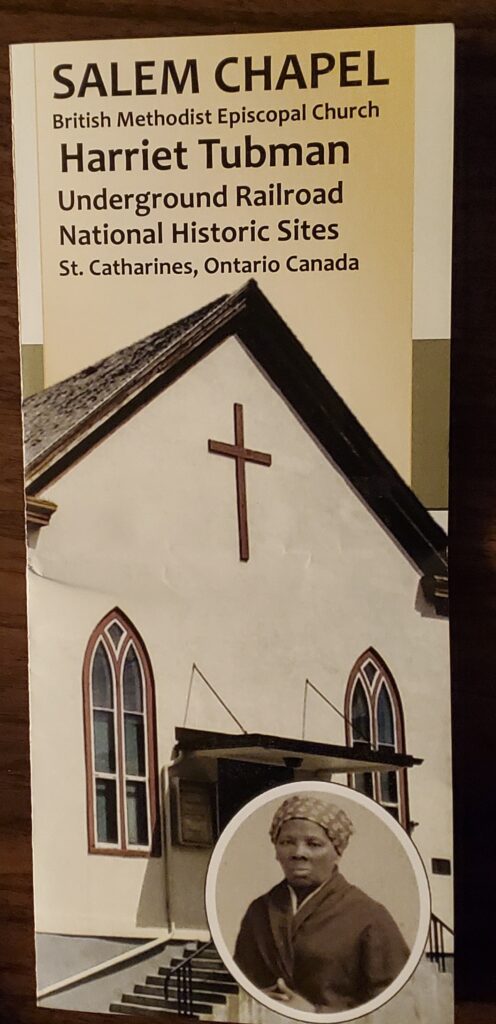
Our knowledgeable tour guide stepped on the bus and shared she wanted to share a little known part of history of Canada. She shared that Salem Chapel in St. Catharines, Ontario Canada was built by 19th century Freedom Seekers. The church historian, Rochelle, and her sister would share more. The Underground Railroad was a network of routes and safe houses leading to freedom for Black enslaved people. Many escapees viewed Canada as their final destination to freedom! We were excited to learn all about this important history!
The church sits on a corner of a busy downtown street in St. Catharines, a small town not far from the border.
Rochelle and her sister Denise greeted us with enthusiasm. We entered the old church with anticipation! A beautiful antique organ graced the sanctuary. Rochelle asked if anyone wanted to play it but there were no takers. A portrait of Harriet Tubman seemed to watch with pride as we solemnly walked in. The beautiful sanctuary can sit around 200 people. The newcomers were considered free men and women in the north due to Canada’s Slavery Abolition Act of 1834, signed by President Lincoln.
Rochelle served as the vibrant and knowledgeable historian. Afterwards, we toured the church, walked upstairs to the balcony, and downstairs to the basement. A monument of Harriet Tubman and historical marker served as a lasting tribute and reminder of the past. Many tour members were alumni of Tennessee State University, a historically Black university (HBCU). We were standing on hallowed ground and chose this site to take pictures. We were fortunate to attend college because Freedom Seekers and Fighters fought for our rights.
We learned in the span of forty years, three African Methodist Episcopal (AME) Churches were constructed by Black American freedom seekers in St. Catharines at different times and in different locations.
Harriet Tubman, the legendary Underground Railroad Conductor (UGRR), was the most celebrated member of Salem Chapel. Her UGRR code name was “Moses” and she extended her route to the Town of St Catharines after the U.S. Government passed the 1850 Fugitive Slave Law. She and eleven Freedom Seekers arrived in the town in December 1851. It was their last stop on the UGRR and served as her base of operations until early 1862. In 1993, she was designated a Person of Provincial Importance in 1993, and a Person of National Significance by the Government of Canada in 2005.
From 1814-1820, an African Methodist Episcopal Society was established in the Queenston Street area. In 1793, a young Black woman named Chloe Cooley was sold as an enslaved person and forced across the Niagara River into the United States. This incident became a catalyst for the passage of the Act Against Slavery in 1793 by the Upper Canada Executive Council. This resulted in a significant step towards the abolition of slavery in the region. The public outrage surrounding this event led to the Lieutenant Governor pushing for legislation prohibiting the importation of slaves, resulting in the gradual abolition of slavery in Upper Canada.
In 1835, the second AME church was built in the heart of the “Colored” Settlement on North Street. This church was able to seat up to seventy people.
In 1855, the third AME church was constructed nearby. It seated up to two hundred and fifty people.
In 1856, most Canadian AME church members refused to attend church services in the U.S. because of the 1850 Fugitive Slave Act. The members voted to separate from the parent body in the U.S. and formed the British Methodist Episcopal Church with headquarters in Canada.
In 1857, the church was rededicated and named Salem Chapel. From 1890-1999, Salem Chapel was designated a Municipal Historic site, a Provincial Historic site, and a National Historic site.
In 2023, the U.S. National Park Service announced Salem Chapel British Methodist Episcopal Church in Ontario as the first international listing in the Underground Railroad Network to Freedom Program.
According to additional research, people of African descent began settling in the St. Catharines, Ontario around 1788 and they brought their religion with them. Many were followers of Rev. John Wesley, the founder of Methodism. He was a staunch abolitionist and advocated for the end of slavery and the slave trade. Many of the freedom seekers that relocated to this area were followers of Bishop Richard Allen, the founder of the African Methodist Episcopal Church.
After the passage of the 1850 Fugitive Slave Act, thousands of free and escaped African Americans living in the Northern States moved to various parts of Canada to secure their safety and freedom.
Salem Chapel hosted anti-slavery lectures, civic protests, and provided shelter and aid to newly arrived freedom seekers until the end of the Civil War. Abolitionist Frederick Douglass also made several stops at Salem Chapel when it sat in the neighborhood once known as “Coloured Village.”
In 2013, Dr. Henry Louis Gates Jr. and Public Broadcasting Service (PBS) featured Salem Chapel and its connection to Harriet Tubman in the award winning documentary The African Americans: Many Rivers to Cross.
Today, Salem Chapel continues as a religious institution and as an international “Sacred Destination” tourist attraction.
Francie Mae. June 15, 2025.
Reference:
Baig, Fakiha. Ontarian church attended by abolionist Harriet Tubman gets upgrades, to reopen for tours. The Canadian Press. Posted February 24, 2023 at 9:47 AM CST. Updated February 24, 2023. Website. Accessed June 15, 2025.