I write and speak about my life growing up in abject poverty in the legally segregated South. I grew up with two parents and four older siblings. Our parents were Christians. They demonstrated their faith consistently and guided us with love and wisdom.
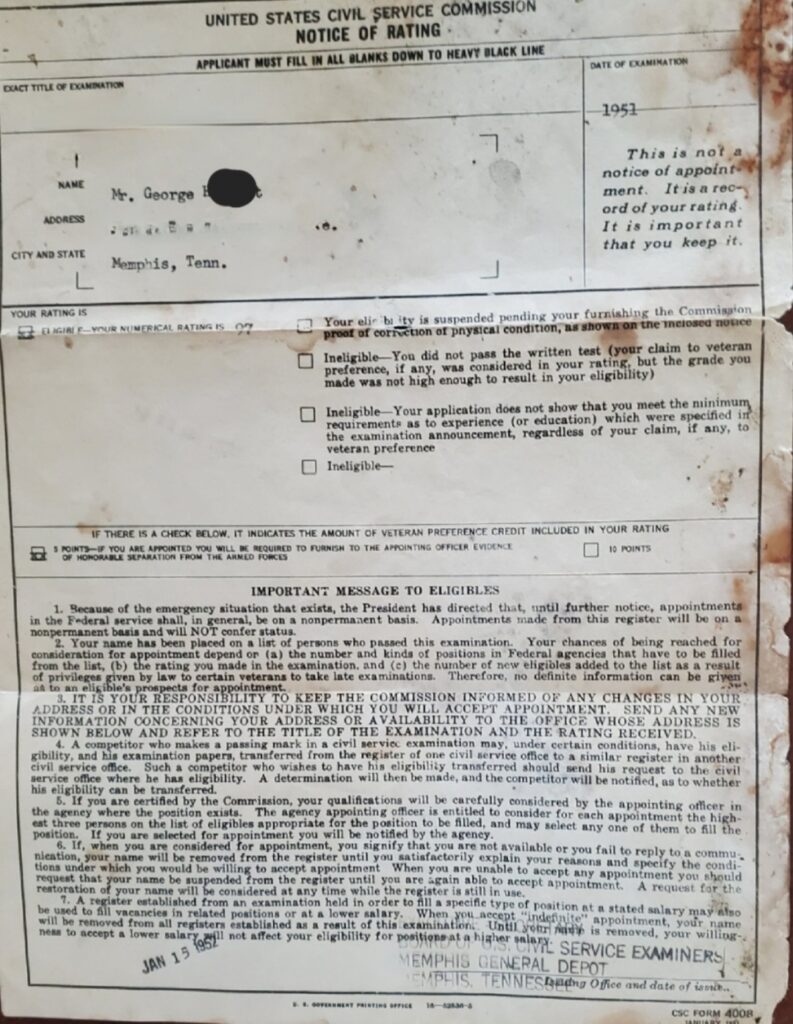
Our father (Dad) served our country during WWII in the legally segregated military (Army). He didn’t talk about it until years later. He kept his discharge papers, civil service exam results, and letters he wrote to our mother (MaDear ) in his military footlocker.
While training to go overseas, Dad was injured and was hospitalized for seven weeks. He wrote many letters home to his bride (MaDear) about his Christian beliefs and a hopeful future. His intention was to save his money and use his G.I. benefits to buy a home. At the time, they were living in Mississippi.
Like so many other Black veterans, Dad was denied G.I. benefits. Racist Senator James O. Eastland and Rep. John Rankin, both of Mississippi, made sure of this. They were discriminated against. He took the Civil Service Examination (CSE) in 1951, and made a cumulative score of 97. He received 5 points for being a veteran. The average CSE score is 70 on a 100 point scale. A competitive score is 90 or above. He obtained temporary employment at the Army Deport in Memphis. He lost this job when a white man needed one. He was not able to obtain gainful employment again until the mid-1960s. He was hired as a janitor in the NCO club at Memphis Naval Air Station, where he worked until he retired.
Our parents were forced to work in cotton fields. Our early childhood was spent in a rural farming community in the suburbs of Memphis, Tennessee. My family and I lived in shacks without electricity or indoor plumbing. We pumped water from a neighbor’s well and carried buckets of water back home. We used coal oil lamps to light the dark evenings and nights.
Our family didn’t have basic necessities or health insurance. Medicare and Medicaid didn’t exist until 1965. MaDear relied on home remedies when we got sick because we couldn’t afford to go to the doctor. When my older brother became severely ill, Dad and I walked from house to house asking for help. We didn’t have any Black neighbors, so we had to pray there were some kind white people. I was only five years old,. but I remember begging my Dad to let me go with him. Finally, a man agreed to help. That man looked into my wide teary eyes and took Dad and my brother to the charity hospital. He had surgery for a ruptured appendix. During those times, ambulance services were not an option for Black people.
Dad had asthma and no health insurance. He stayed up all night near the coal oil lamp with a rag over his head, breathing in an awful smelling powder in an effort to get relief. In the morning, he had to go to the field to try to earn money to feed his hungry family.
I had motion sickness. My siblings and I rode on a school bus thirty two miles round trip to and from a Black school. We couldn’t attend the local all -white schools. My parents took me to the local white doctor for treatment. We had to wait in the separate waiting room labeled “colored” and were seen after all the white people. Our parents had to scrounge for money to pay the doctor. Apparently the doctor gave me some medicine to take and told them how to manage my motion sickness. I wondered how other Black children with motion sickness managed to ride miles on school buses to and from school. Did some of them drop out of school because they couldn’t tolerate the long and bumpy ride?
When I was almost 15 years old, we moved back to Memphis. This was the first time we had electricity and indoor plumbing. We lived across the street from a vocational school. There were students of different races and ages attending the school. I watched them come and go. My curiosity got the best of me so one day; I walked across the street to the school. The students were older than me and as they passed by, they probably wondered what I was doing there. I wandered into the office not knowing what to expect. The white lady behind the desk smiled at me and inquired why I was there. I told her I lived across the street and wondered what type of school this was. Because I showed an interest, she stopped what she was doing and showed me around. She told me the school provided hands on training for people interested in auto mechanics, skilled trades, and healthcare. As we peeked into classrooms filled with students, I saw people who seemed interested in learning. I asked her what kind of healthcare, and she told me they trained students to be licensed vocational nurses.
This was a turning point for me. I saw and heard the progress Black people were finally making. More people were in a position to bring awareness to the plight of our race. There were good people in all races, and I learned to recognize the difference. I made up my mind that I would study to become a nurse, just like the students in the vocational school. This career would be a pathway out of poverty.
The next year, we moved to a housing project within walking distance of downtown Memphis. It was comforting to know that I could have a career of my choice. I was inspired by the nursing students I saw at the vocational school, but I didn’t feel an immediate passion. I wanted a career where I could earn money and make a difference. To help me make a decision, I sought out advice from the school guidance counselor. She suggested that I volunteer as a candy striper.
I trained with a large group of Black and white teenagers who were interested in volunteering. Wearing a uniform that looked like a candy cane, I walked from my home in the housing projects to St. Joseph Hospital, located near downtown Memphis. Strangely enough, I was sixteen years old, had never been inside a hospital and didn’t know what to expect. This was the same hospital where Dr. King was taken after he was assassinated. While walking to the conference room to meet my mentor, I couldn’t help but notice Black and white people dressed in various uniforms rushing along the corridors or transporting people in stretchers. I thought about how the team of nurses, doctors, and the rest of the hospital staff didn’t let their racial or political differences prevent them from providing care to patients. I imagined they didn’t see the race of the patients they cared for. In the hospital, I saw people of all ages, genders and races working together for a common cause. They made a difference in the lives of people. They had valuable careers that allowed them to remain employed and make a difference. My decision was made; I would go to college and become a registered nurse!
There are many races of people who wouldn’t succeed without DEI Programs. In spite of scoring a 97 on the Civil Service Examination, Dad was excluded from gainful employment. Diversity, Equity, and Inclusion (DEI) challenges existing inequalities and allows the opportunity for everyone to succeed regardless of race of background.
Francie Mae. February 28, 2026.