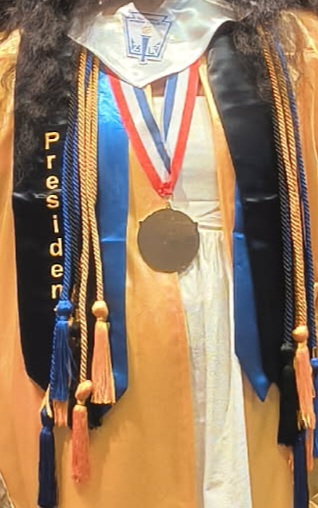
Graduation is always an exciting time for me. It means you’ve completed the necessary requirements to earn a diploma or degree. Commencement, on the other hand, is the ceremony that honors graduating students. It is also an exciting time. It refers to the start of something new. For many, it is the start of your career or the next phase in your life. It’s the time to receive well-earned honors like “summa cum laude.”, “magna cum laude,” “cum laude,” or “thank you Lordy.” Regardless, it’s a special moment in time.
This year, my bonus granddaughter graduated from high school with honors. In spite of health challenges the last two years of high school, she persevered. Her divorced parents, relatives, school administrators, and classmates were her biggest cheerleaders. She even worked a part-time job. She was class president for the last four years of high school and participated in extra- curricular activities. She gave an emotional and humorous speech at her commencement ceremony. She turned her challenges into strengths and earned a full scholarship to college. I hope her testimony will inspire others.
After I listened to her speech, attended her graduation party, and showed my skills on the dance floor, it was time for me to reflect. After divorcing when my two daughters were toddlers, I raised them as a single parent. Their journey had challenges as well, but we persevered. They tested for and attended optional schools. I was determined they would receive the best education possible. They also participated in extracurricular activities, were members of the honor society, cheerleaders, and earned scholarships to college. They are now married with rewarding careers and families of their own.
Being single or divorced is no reason not to invest in your children’s future. In fact, you should invest more.
My four siblings and I grew up in poverty. Our parents invested in us. We graduated high school and went to trade school, business school, or college. According to research, the graduation rate among children from low-income families is much lower than their peers. This was not the case when my siblings and I were in school. The majority of our classmates were from poor or low-income families. What is robbing poor children from sharing in the excitement of graduation?
Recent research also indicates that children from low income families face challenges in reading and mathematics proficiency, which can hinder their academic performances. Parents must invest in their children’s future. Our mother had a 6th grade education and our father had an 11th grade education. Initially, our mother taught us to read and our father taught us math. Our teachers, principals, and school staff poured into us and our fellow students. Our oldest sibling graduated with honors, was class salutatorian, class president and student council president. Our next oldest sibling was voted most talented. We all participated in extracurricular activities and excelled based on our talents.
I don’t believe children can’t excel because they are poor or parents are divorced. Sometimes parents, families, and school administrators are not invested in students. The students may act out, or drop out of school. Unfortunately, this is a repetitive cycle. I believe all students want to learn and experience graduation.
About a year ago, I was invited to speak with students in 6th, 7th, and 8th grades. They were from a lower income school district, but they were eager to learn. Their teachers and school administrators seemed supportive. I shared my story of growing up in poverty and obstacles I overcame. The students listened attentively and asked questions. Because I grew up in poverty, they seemed to connect. After successful careers I’m now retired, but they seemed to get a glimpse into the future. As encouragement, I brought small gifts with positive messages for each student. Regardless of economic or family status, the children are our future.
My granddaughter recently completed 6th grade and she’s following in the footsteps of her parents, grandparents, and other family members that came before her. Like the children I spoke with, she eager to learn. It’s up to us to teach them well, so they can lead the way!
Francie Mae. May 26. 2025.
Reference
National Center for Education Statistics. (2024). Characteristics of Children’s Families. Condition of Education. U.S. Department of Education, Institute of Education Sciences. Web. Accessed 5/26/25.