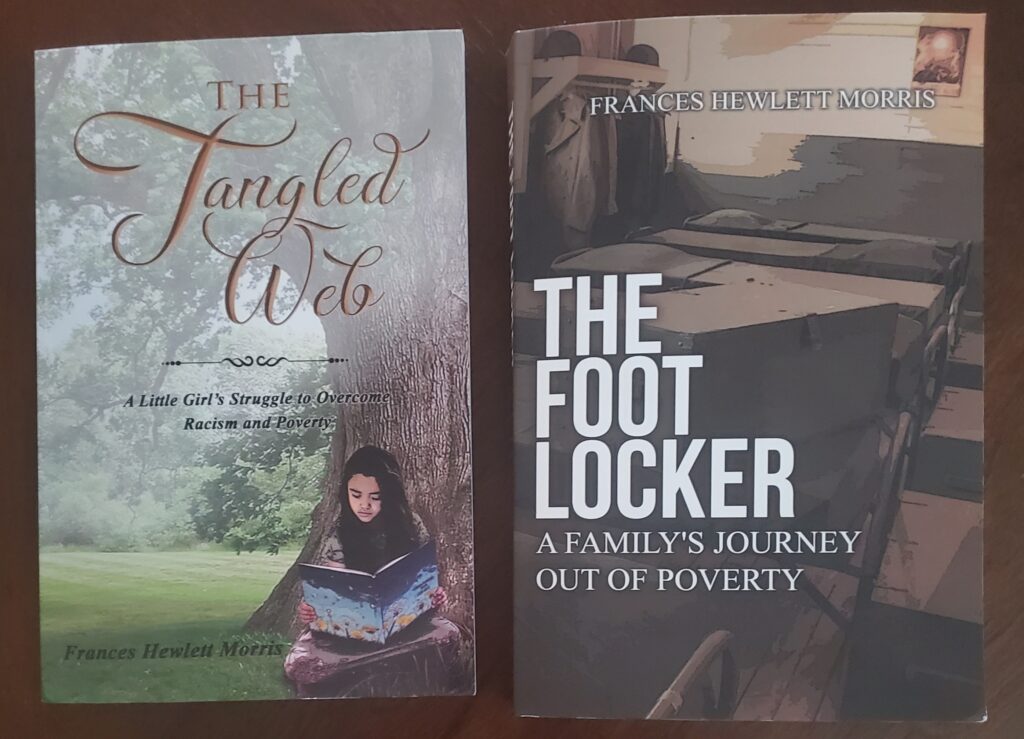
I believe poverty is man-made. When I published my memoirs, “The Tangled Web: A Little Girl’s Struggle to Understand Racism and Poverty,” and “The Footlocker: A Family’s Journey out Of Poverty,” I made mention of this. Some reader’s asked me what I meant by this.
My family and I lived in poverty as a direct result of legal Jim Crow laws. There were many other families like mine. Those laws were man –made because they were the direct result of human actions, policies, and systemic injustices. Laws were made to legalize racial segregation and marginalize Black Americans. There were limited job opportunities and access to housing. These racist measures and many others kept Black Americans economically disadvantaged.
Most Southern states have a poverty rate above the national average. Many are states where enslavement of humans was prevalent prior to the Civil War. There are limited job opportunities and lower than average incomes.
According to the Economic Policy Institute, the Southern economic development model is a set of economic policies that can be traced back to the end of slavery when wealthy, powerful Southerners sought to continue to extract the labor of Black men and women with as little compensation as possible. The specific components of this model include ensuring low wages for workers, limiting regulations on businesses, implementing regressive tax systems, maintaining weak social safety nets, and enforcing a fierce anti-union stance.
According to an excellent and detailed articles written by Chandra Childers, “This development model emerged after slavery was outlawed in an intentional effort to continue accessing the labor of Black men and women with as little compensation as possible. This meant the lowest possible wages (if paid at all), a weak safety net for workers, few regulations on businesses, and the prevention of worker empowerment at all costs.
I write about how my family was affected by racist laws and policies. Our father served in the U.S. Army, was injured, and after discharge he was denied G.I. benefits. His cumulative score on the Civil Service Examination was 97. He was hired at the Memphis Army Depot but was let go because “a white man needed to feed his family.” It took over 12 years to obtain gainful employment. Even then, he was hired as a janitor at the Naval Air Station in Millington. Prior to this, we lived in shacks without electricity or indoor plumbing. He and our mother picked and chopped cotton to feed their hungry family.
Childers writes, “Today, this model is presented as a way to attract businesses, create jobs, and ensure broad, shared prosperity while obscuring its true roots. The data in this report and across this series, however, have shown that this model has repeatedly failed to provide for the basic economic security, let alone prosperity, of workers and families across the region. This is because the model was not designed for this purpose and cannot achieve this outcome. Policies that would facilitate broadly shared prosperity for Southerners of all backgrounds include empowering workers, respecting their right to organize and form unions, raising the minimum wage to a living wage, strengthening the social safety net, and ensuring adequate funding for public schools and healthy communities. These are the policies that support families and enable their success.”
The Census Bureau has produced poverty estimates since the 1960s.
According to the U.S. Census Bureau
- In 2024, the official poverty rate fell 0.4 percentage points to 10.6 percent. There were 35.9 million people in poverty in 2024.
- Between 2023 and 2024, the official poverty rate decreased for White, Asian, and Hispanic individuals, but did not change significantly for other race groups discussed in this report.
According to reports, the expiration of enhanced federal assistance progress and safety net programs led to the reversal of pandemic-era gains.
Based on my family’s experience, most people want to work and be productive. Congress must support investments in programs that support people living in, or at risk, for living in poverty.
To start, there must be good-paying jobs, an increase in the minimum wage, expansion of tax credits (such as earned income and the Child Tax Credit) , expand safety net and SNAP programs, access to decent affordable housing, health and child care, access to quality education and job training.
Utilizing some of these programs lifted my family out of poverty and as a result, we remained out.
Francie Mae, March 30, 2026.
References
1.Childrers, Chandra. May 6, 2024. Economic Policy Institute. “The evolution of the Southern economic development strategy. Rooted in Racism and Economic Exploitation: Part One. Accessed March 29, 2026.
2. Census. gov. Census Bureau. Website. “How the Census Bureau Measures Poverty. January 13, 2026.. Accessed March 29, 2026.