As written in part one, our travel group arrived at Accra (Kotoka) International Airport in Accra, Ghana and we were immediately greeted with “Akwaaba-Welcome Home!”
Our world is made by history and because knowledge of the past offers new perspectives about the present, I welcomed this deeper insight into the lives of my ancestors. This journey was emotional, educational, and enlightening.
After arriving, our local tour guide took us on a bus tour to the prestigious University of Ghana, home to over 1, 500 international students. It’s the oldest and largest public university in Ghana and was founded in 1948 as a college. It gained full university status in 1961 after Ghana achieved independence from Britain.
After touring the university, we rode around in the city. School children were walking home from school. Their uniforms were crisp and all the girls had short cropped hair. According to the tour guide, girls in public school are required to cut their hair cut short. Reportedly, in 2025, the Minister of Education thought hair was a deterrent to learning. He thought education was to mold character, not rivalry, and not to be used as a beauty contest. As a Black American with long curly hair, this made no sense to me. It should be a personal choice.
We stayed at beautiful five and four star hotels. Our group visited so many wonders like Manhayia Palace, Okomo Anokye Sword (Golden Stool), craft villages to see kente cloth spun on looms, Artisan shops to see how dye is made from tree bark, and saw beautiful woodcarving!
I was anxious to visit Dr. W.E.B. DuBois Center. I grew up reading some of his books. He’s an undergraduate of Fisk University in Nashville and he and his wife moved to Ghana in 1961. He remained there until his death in 1963.
Independence Square in Accra was our next stop. Ghana gained independence from the British in 1957. The Black Star Square is part of Independence Square and is topped by the Black Star of Africa. Our next stop was to Dr. Kwame Krumah Park. He was a former president of Ghana. He wrote, “I am not African because I was born in Africa but because Africa was born in me.”
After a couple days in Accra, we rode approximately 5-6 hours to Kumasi, home of the Ashanti Kingdom and the sacred Golden Stool, which symbolized the soul and unity of the kingdom. The Kejetia Market is the largest open-air marked in West Africa.
All across Africa, women, and a few men, carried produce, water, and goods on their head. We were told they learned this practice from childhood. The weight is centered directly over the spine and core. I watched in awe as they balanced these items on their heads and secretly vowed to practice after I returned home.
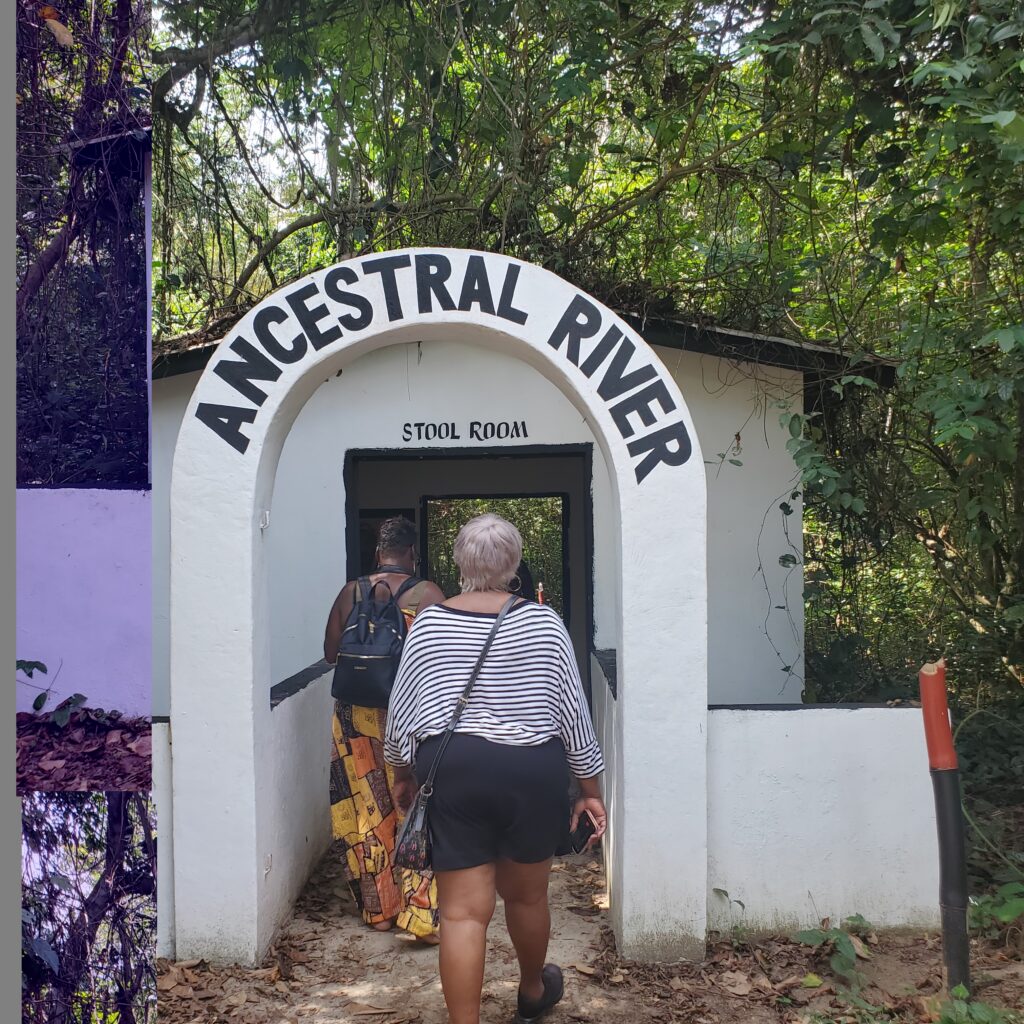
The emotional part of the journey was difficult. We walked in the footsteps of our ancestors to Ancestor River. Our captured ancestors walked barefoot and single file to the river for their last bath before walking over 40 miles to the slave dungeons. We traced their footsteps to the river. Some of us took off our shoes before walking in silence single file. When we got to the river, we stepped in and stood in silence.
Our ancestors were tied with ball and chains as they walked to the slave dungeons. The first dungeon we visited was Elmina Dungeon. They were only fed once a day, and had no access to bathrooms. Some were held in these dark cramped dungeons for up to three months. Many died. The Door of No Return is where millions of captured Africans took the final steps from their home continent onto slave ships.
The next day, we traveled to Cape Coast, Ghana. Thousands of African captives didn’t survive this dungeon. Their bodies were laid out for captives to see. The irony is a church above the dungeon.
As we stood in these cramped dungeons, we were deep in thought or prayer. The tears flowed easy. Our guide pointed out the narrow door from this dark dungeon. Our ancestors were forced through these doors to awaiting slave ships on the Atlantic Ocean.
Our final stop in the dungeon was to attend a “Fihankra Ceremony.” This symbolic and communal rite of passage is designed to reconnect people of African descent in the diaspora with their ancestral roots and cultural heritage.
The next stop was to the village for our naming ceremony with the local chief, queen mothers, and elders. We were required to wear white. Young villagers welcomed us with a contagious high energy dance and drum performance. We waited patiently until it was our turn to go through the naming process, and receive a certificate with our African name!
On the way back to Accra, we visited Kakum National Park, and with guides, walked the above tree level canopy walkway. The guides assured us the forest animals were nocturnal.
We have a fabulous Farewell Dinner on our last night. The energetic Keno Dance Ensemble engaged and entertained us. Yes, we danced with them!
Even though it was emotional, what a great journey to our ancestral home!
Francie Mae. October 25, 2026.